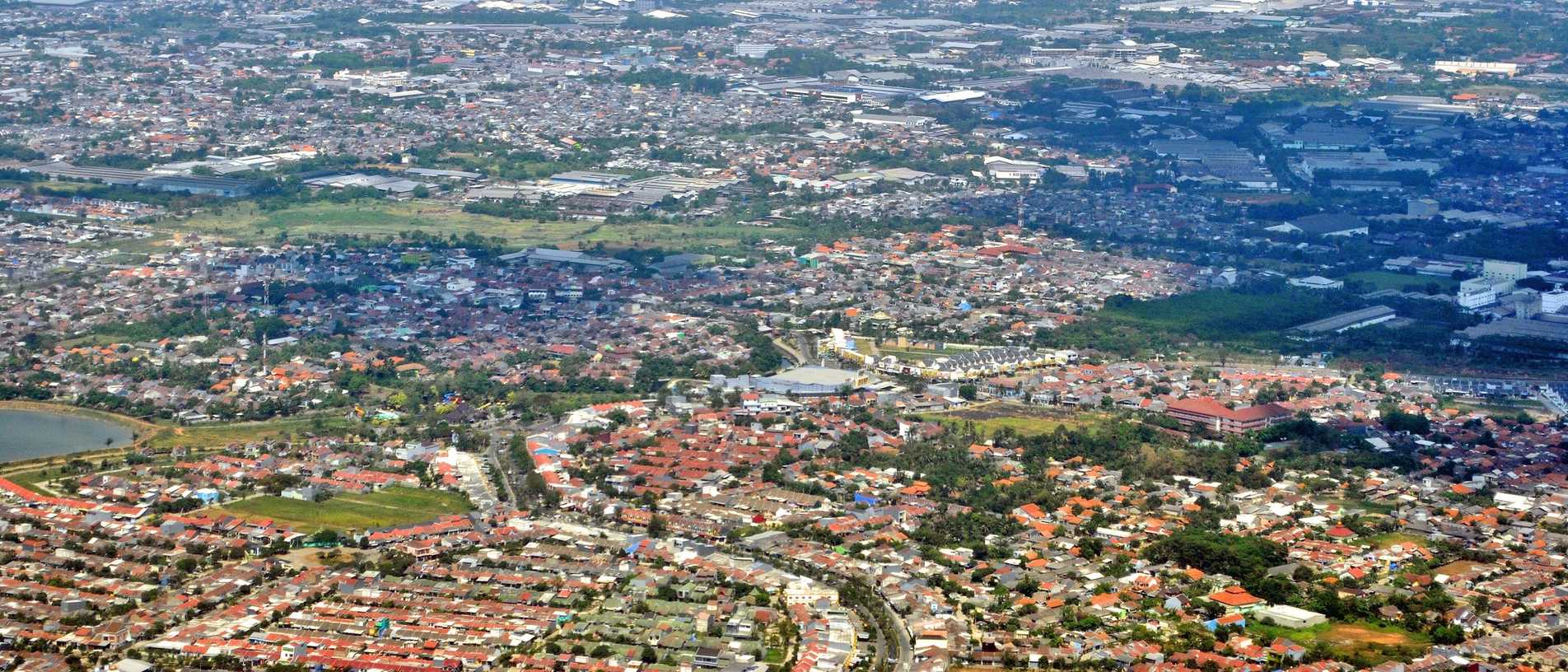
Photo: Aerial view of Tangerang and its landed-housing sprawl (red roofs) · by Ya, saya inBaliTimur · via Wikimedia Commons · CC BY-SA 2.0
This Month's Verdict
Developers cut new launches by 65% — yet take-up on what's already launched sits at 94%. This isn't a demand collapse; it's deliberate supply contraction: the market is “shrinking volume to hold price”
Scope note: Landed Residential — houses with land, detached or terraced, the Indonesian middle-class family's mainstream home and local developers' core battlefield. Read three H1 2026 numbers together: 2,257 new units launched (-64.9%), a 94.0% take-up rate (above the 93.5% historical average), and 8.3 units sold per project per month (-40.6%). Developers aren't refusing to launch because homes won't sell — they're waiting: for rates to peak, for global uncertainty to settle. And the pricier, the better it sells: unit transactions fell 40.6% while transaction value fell only 19% — mass-market buyers are pinned down by the 5.75% policy rate and 8–9% mortgages, while wealthy buyers pay cash and don't care about rates at all. 73% of new launches were in Tangerang: malls, factories, housing — our reports keep landing on the same conclusion: Greater Jakarta's growth story is written outside the city.
Three Numbers
-64.9%
So what: only 2,257 new units launched in H1 — developers collectively “stopped opening”. Not because homes won't sell, but because they don't dare. Their vote: concentrate what little they launch into the upper-middle and upper segments — in a downturn, high-end purchasing power is the most resilient. Chinese developers know this logic well.
So what: the overall take-up rate is 94.0%, above the 93.5% historical average — what's already launched is actually selling fine. Demand growth of +0.55% QoQ is a clear slowdown but not negative: buyers are hesitating, not leaving. That is the foundation of “shrinking volume to hold price”.
Source: Cushman & Wakefield H1 2026 take-up and demand statistics
8.3 units
Counter-evidence: 8.3 units per project per month, -40.6% YoY — volume really has stalled; rate-pinned mass-market demand is real. But the other line of the same ledger: monthly transaction value per project is IDR 24bn, down only 19%. Units halved, value down a fifth — expensive homes still sell. The market hasn't collapsed; it has changed buyers.
Macro backdrop: Indonesia 2026 GDP growth 5.2%, inflation 3.34%, central bank rate 5.75% (a cumulative +100bp in May–June, the highest in a year). Connect the numbers: developers are waiting for rates to peak and concentrating launches in the resilient upper segments — land prices rose just 1.38% in a year while house prices rose 1.95%; the gap is construction cost pushing, not demand.
Metric
H1 2026
Change
Plain reading
New launches
2,257 units
-64.9%
Developers collectively “stopped opening” — not unsellable, unlaunched
Overall take-up rate
94.0%
Above the 93.5% historical average
What's already launched sells fine
Demand growth
+0.55% QoQ
Clear slowdown
Buyers are hesitating, not leaving
Sales per project / month
8.3 units
-40.6%
Volume has stalled
Value per project / month
IDR 24bn
-19%
Units halved, value down a fifth — expensive homes still sell
Avg residential land price
IDR 12,814,556 /sqm
+1.38%
Land prices essentially flat
Overall house price
——
+1.95%
Outpacing land — construction cost pushing, not demand
Source: Cushman & Wakefield, Greater Jakarta Landed Residential MarketBeat H1 2026; macro figures cited by that report from Bank Indonesia and BPS.
The map: one city, Tangerang, decides the metro's color
Only one thing matters when reading the map: follow the infrastructure and the industrial parks. Tangerang wins on the airport, the toll roads and decades of township-building — half the metro's stock, and 73% of H1 launches. Bekasi posts the highest take-up rate citywide, the first stop for Jakarta-commuting mass-market spillover. Whether Karawang housing heats up depends on how many workers its factories hire.
Submarket
Stock (units)
Take-up
Land price (IDR/sqm)
Equator note
Tangerang
231,722
94.4%
14,897,397
The undisputed home ground: half the metro's stock and 73% of H1 launches. The satellite-city protagonist, confirmed by data for the third time
Bekasi
101,085
95.9%
11,054,627
Highest take-up citywide — the first stop for mass-market spillover commuting into Jakarta; steady on both volume and price
Bogor-Depok
93,883
92.9%
9,068,431
Cheapest land of the main markets — home to value-for-money mass-market projects
Jakarta
27,579
87.4%
16,237,770
Priciest land, lowest take-up — no land left in the city; high-end projects sell slowly
Karawang
1,165
83.1%
6,840,244
Industrial-zone housing just getting started — it follows factory payrolls
Metro total
455,434
94.0%
12,814,556
Tangerang's weight decides the metro's color
Source: Cushman & Wakefield H1 2026 submarket statistics; Karawang land prices are excluded from the metro average for being below it.
H1's notable launches: almost all familiar faces
What did launch in H1 was almost entirely late phases of big developers' townships — testing the water with high-end clusters, with PIK 2 continuing to release stock and the Chinese-Indonesian districts staying hot.
Project (H1 selection)
Location
Units
Positioning & signal
The Ubud @ Pantai Indah Kapuk 2
Tangerang
48
Upper (UP) — PIK 2 keeps releasing; the Chinese-Indonesian district stays hot
Philo @ Alam Sutera 2
Tangerang
215
Middle to upper-middle — the largest single launch of H1
Castilo @ Terravia (BSD City)
Tangerang
109
Upper-middle to upper — BSD remains the upgrader's home ground
Finore (Park Serpong phase 2)
Tangerang
133
Upper — developers testing the water with high-end clusters
The price ledger: four price bands, four kinds of buyers
A blunt sense of place for Chinese readers: a mid-market terraced house in Greater Jakarta costs roughly RMB 400k–790k — county-town money in China, a lifetime mortgage for an Indonesian middle-class family here. And the IDR 10bn threshold for foreign individual buyers (~RMB 4mn) means “a Chinese individual buying a Jakarta villa” is practically a dead end — apartments (threshold IDR 3–5bn) are the only realistic personal purchase path.
Segment
Price band
RMB equivalent
Who's buying
Middle
IDR 1–2bn /unit
~RMB 400k–790k
The mass-market backbone, 27.8% of demand — but the most rate-sensitive, now waiting
Upper-Middle
IDR 2bn+ /unit
~RMB 790k+
23.6% of new launches; upgrader families, less rate-sensitive
Upper
IDR 3.5bn+ /unit
~RMB 1.39m+
25.7% of new launches; high-net-worth buyers, mostly cash or low leverage
Foreign individuals
Threshold IDR 10bn (Jakarta landed)
~RMB 4m
Effectively excluded — landed houses are a dead end for foreign individuals
Price bands as defined by the source report; FX at IDR 17,917/USD and ~7.1 RMB/USD. Foreign-ownership thresholds follow ATR/BPN Ministerial Regulation 1241/2022 and public interpretations — sources differ; verify with a PPAT notary before transacting (verified Sep 21, 2026).
When This Verdict Breaks
① This report relies on a single agency's dataset (Cushman & Wakefield); absorption is measured on a sample-estate basis, not unit-by-unit citywide, verified as of Sep 21, 2026 — re-verify against the latest quarter before transacting. ② If the central bank starts cutting and mortgage rates fall meaningfully, the “mass market pinned, shrink volume to hold price” verdict must be revisited. ③ The PPN DTP VAT subsidy runs to December 2027; eligibility and caps follow the Ministry of Finance's current rules — don't treat the subsidy as permanent. ④ The price bands (Middle/Upper-Middle/Upper) are the source report's definitions and don't map cleanly onto China's “rigid-demand / upgrader / luxury” vocabulary. ⑤ “Shrinking volume to hold price” and the “land negotiation window” are advisory judgments, not statistics in this report. This is a business reference, not legal or investment advice.
Evidence & Action
Policy and rates: one red envelope, one hanging knife
The envelope is the government's: the 100% VAT subsidy (PPN DTP) has been extended to December 2027, covering homes priced up to IDR 5bn (~RMB 2m), with the subsidy capped at the first IDR 2bn of the price — at the 12% VAT rate, that's up to ~IDR 240m (~RMB 95k) saved. A genuine buying window for mass-market and upgrader buyers, and one reason developers dare to launch in H2 (eligibility follows the Ministry of Finance's current rules).
The knife is the central bank's: the policy rate rose a cumulative 100bp to 5.75% in May–June, and mortgage-rate transmission typically lags 6–12 months — today's 8–9% mortgages don't yet fully reflect this hike. That means borrowing costs may keep rising into next year: mass-market buyers will wait longer, and those already repaying face payment resets. Until the knife falls, developers won't launch at scale.
Equator's take: four implications for Chinese readers
Owner-occupiers (with legal residency): the policy window is worth using★★★
The VAT subsidy runs to end-2027, developers are shrinking volume to hold price, and a higher high-end mix has squeezed out negotiating room in mid-market projects — stack the three, and a buyer with legal residency who clears the threshold has more room to negotiate than two years ago. But do the mortgage math first: transmission isn't finished, so stress-test the payment against another +1pp.
Chinese developers: don't bring the domestic “mass-market fast-turnover” model★★★
Indonesia's mass-market segment is extremely rate-sensitive and slow-moving (8.3 units per project per month), while the high end is resilient and cash-heavy. Local majors build townships in phases, testing each phase NUP-style before scaling — the fast-turnover land-finance model has no soil here. If you build, build slow: small launches, high-end anchoring, self-funded cash flow.
Land deserves more study than houses★★☆
Land rose 1.38% in a year, house prices 1.95% — the difference is construction cost. Developer margins are being squeezed, which means: landholders are holding back, and land seekers have room to negotiate. For developers or industrial capital entering Indonesia, this is actually a window to talk land cooperation — especially leftover plots along the mature Tangerang and Bekasi corridors.
For investors: this market has no short-term story★★
Flat land prices, high rates, a IDR 10bn foreigner threshold — any one of the three kills the short trade. There is exactly one investment logic in Indonesian landed housing: a ten-year hold along the population and industrial corridors, earning the slow money of urbanization. If you want fast money, this market will teach you about liquidity.
Red Lines (six operating boundaries)
01
Foreigner threshold: IDR 10bn minimum + Hak Pakai onlyBelow the threshold, a landed house cannot be registered to a foreign individual — apartments (IDR 3–5bn threshold) are the only realistic path
02
Nominee holding: void from the startBuying land or houses through a local nominee is legally void from day one — everyone who falls into this pit believed they were the exception
03
Rate stress test: price the mortgage at +1–1.5ppThe 100bp hiked in May–June hasn't fully transmitted — stress-test before signing
04
Late-phase township risk: schools and malls on the master plan may stay on the master planIndonesian townships take 20–30 years to build out — verify occupancy and delivered amenities in completed phases before buying late-phase plots
05
Policy shelf life: the subsidy ends Dec 2027 — don't treat it as permanentPPN DTP eligibility and caps follow the Ministry of Finance's current rules (verified Sep 21, 2026)
06
FX exposure: model the exchange rate as its own variableThe house is a rupiah asset — if your income or capital is in RMB/USD, FX moves alone can exceed the price gain over your holding period
2-hour diagnosis
两小时诊断
Slow money in housing starts with two hours of fast math. Purchase paths, developer entry strategy, land-cooperation modeling — bring your questions and we'll run the numbers against your budget and family plan. The first coffee is on us.
Data note: this report is Equator Creative Consulting's Chinese-language interpretation of Cushman & Wakefield's MarketBeat: Greater Jakarta Landed Residential H1 2026 (published 2026); underlying data copyright belongs to Cushman & Wakefield. Macro figures are cited by that report from Bank Indonesia and BPS. Foreign-ownership rules follow Indonesia's PP 18/2021, ATR/BPN Ministerial Regulation 1241/2022 and public legal interpretations, verified Sep 21, 2026. FX: IDR 17,917/USD (source report); RMB at ~7.1 per dollar. Limitations: ① single-agency dataset; ② absorption measured on a sample-estate basis, not unit-by-unit citywide; ④ price bands (Middle/Upper-Middle/Upper) are the source report's definitions and don't map cleanly onto Chinese market vocabulary; ⑤ “shrinking volume to hold price” and the “land negotiation window” are advisory judgments, not report statistics. This is a business reference, not legal or investment advice.