Equator ObservatoryEquator Observatory
Construction Contractor Special · 2026.09
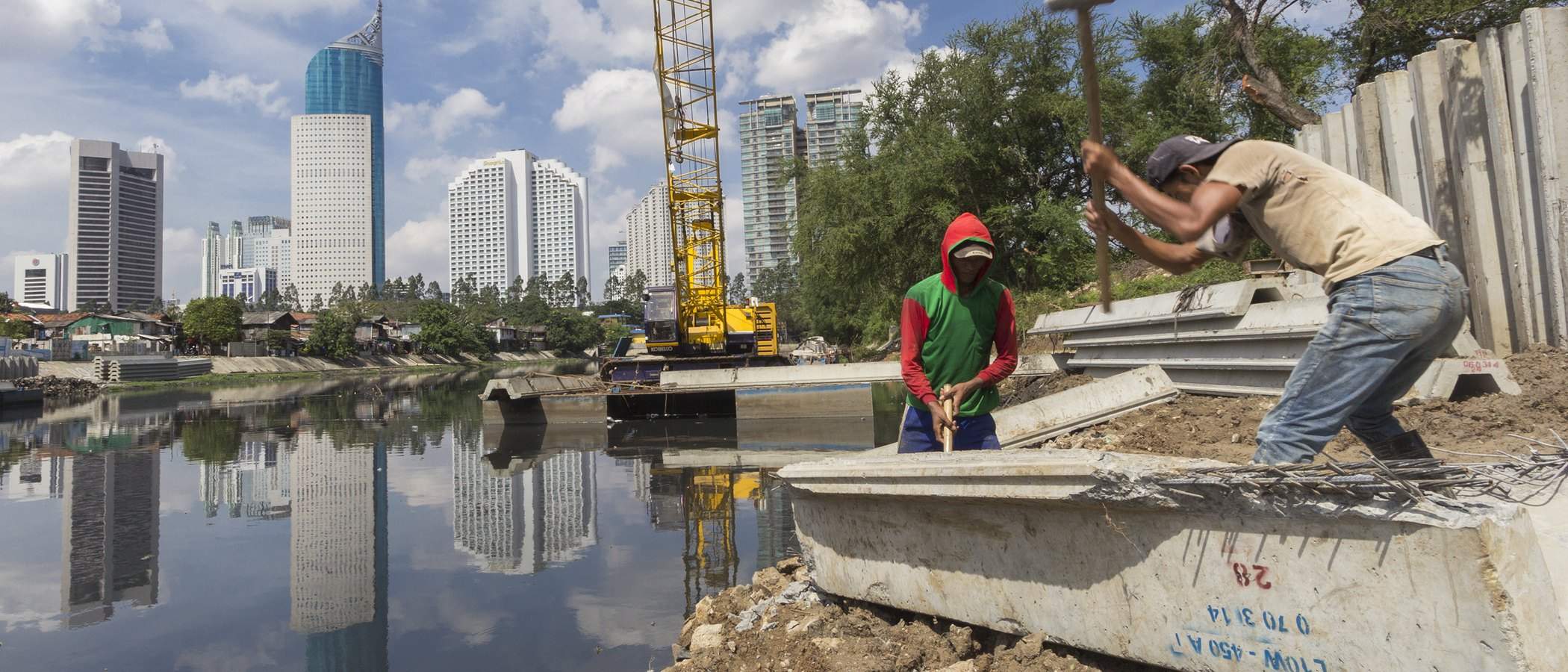
Photo: Herusutimbul / Wikimedia Commons, Melati Reservoir revitalisation, Jakarta; cropped and resized, CC BY-SA 4.0 ·
Source ·
LicenceH1 2026 · Market & Project Pipeline
Indonesia Construction Contractors & Project Pipeline: From Investment Signals to Camp Orders
Indonesia construction contractor landscape and project pipeline · H1 2026 briefing
This month's verdict: For modular accommodation suppliers, delivery plans and camp procurement at mobilised projects are closer to orders than headline investment intentions. Confirm budget, procurement owner, technical scope and payment milestones before committing sales resources.
Two verifiable signals
9.83%
Construction's share of Indonesia's 2025 GDP; it ranked fourth by sector contribution.
Statistics Indonesia (BPS), Construction Indicators Q1 2026
IDR 74.54T
Estimated private investment that had entered IKN by August 2026, involving 67 investors.
IKN Authority, 7 Aug 2026; not awarded contractor value
IDR 134.22T
Value of projects under the government-business partnership (KPBU) scheme in the same official update.
IKN Authority, 7 Aug 2026; project value is not cash paid or contracts awarded
Market size: advisor estimates, not an order book
The supplied report estimates Indonesia's 2026 construction market at USD 45–50bn, with infrastructure at USD 15–18bn, industrial plants at USD 10–12bn and commercial/residential at USD 20–25bn. The report itself notes that the segment ranges add to USD 45–55bn and do not reconcile to the headline range; it supplies no reproducible model or consistent statistical basis. These figures are directional estimates only: do not add them, present them as official statistics or convert them into camp procurement opportunity.
Data boundary
The market ranges combine multiple sources and advisor judgement rather than one BPS series. Segment and total ranges do not fully reconcile. Pipeline amounts, years and accommodation demand are leads, not proof of financing, construction, award or camp procurement.
Contractor layers: procurement entry depends on project type
| Contractor layer | Examples in source report | Typical project types | Camp entry point |
|---|
| Major SOEs & infrastructure general contractors | CSCEC, CCCC, PowerChina, and Indonesian firms Waskita and Adhi Karya | Rail, roads, power and water infrastructure | Project offices and large camps; establish whether the contractor self-builds or uses a designated supplier |
| Industrial EPC contractors | MCC, Sinosteel International and ENFI (as listed in the source report) | Smelters, processing plants and industrial parks | Plant-support dormitories and technical staff housing; clarify owner, EPC and subcontractor responsibilities |
| Local private builders | Construction teams with Fujian, Zhejiang and Jiangsu ties (source-report grouping) | Factories, warehouses and smaller commercial builds | Small project offices and short-term housing; delivery speed, landed cost and local service matter |
Company names are market-observation examples from the supplied report, not a live-project list, endorsement or complete ranking. Verify the legal entity, Indonesian presence, project status and actual procurement owner before outreach.
Project pipeline: separate planning, construction and procurement
The table retains opportunity areas from the source report and adds stage boundaries. Only projects with a clear funding path, active mobilisation, camp procurement and acceptable payment terms should enter an actionable sales forecast.
| Opportunity area | Stage assessment | Accommodation implication | Next item to verify |
|---|
| IKN capital development | Multiple funding channels; private investment and KPBU project value are separate official totals | Active government facilities, roads and water projects may create site demand; packages have different schedules and buyers | Specific package, award notice, mobilisation date, contractor and camp procurement plan |
| Jakarta–Surabaya rail extension | Described in the source report as planning / financing pending; do not list as confirmed construction | Exclude from near-term sales forecast; track developments | Formal government decision, financing, tender and commencement notice |
| Karawang & Bekasi industrial parks | Recurring factory and park opportunities; each project has its own status | Demand depends on tenant, contractor, crew size and schedule | Tenant and main contractor, budget, land/permits and whether housing is in scope |
| Morowali & Weda Bay smelters | Existing and expansion projects coexist; source-report amounts are not independently audited | Remote camps, shift housing and support services may be required, subject to project validation | Owner capex, environmental permits, construction status, headcount curve and camp procurement |
| Jakarta & Batam data centres | Source report identifies a 2024–2027 demand window; verify each investment and start date | MEP, network and security requirements may exceed standard site housing | Developer, main/subcontractors, schedule, HSE/security and technical staff housing brief |
Five gates from lead to quotable opportunity
Confirm the project entity and stagePlan ≠ mobilisation
Use owner or government notices to confirm package, main contractor and site status. Media intentions, MoUs and investment plans are leads only.
Map the procurement pathWho signs?
Find out whether the camp is self-built by the main contractor, purchased by the owner, sourced from a designated vendor or subcontracted. Identify the buyer with authority.
Lock headcount, specification and delivery windowTurn need into a brief
Validate peak headcount, shifts, site access, service life, fire/sanitation, transport, lifting and local assembly.
Review cash flow and contract termsValue is not cash
The source report describes payment across engineering milestones at large contractors. Its 3–6 month cycle is advisor experience, not an industry-wide statistic. Check advance payment, acceptance, retention, variations and dispute clauses.
Prove delivery and compliance capabilityLocal service is a gate
Validate Indonesian contractor requirements, labour and environmental obligations, logistics, local crews, spare parts and after-sales response before bidding.
Six commercial red lines
01Do not bet only on IKNLong timelines; verify each package.
02Do not treat intent as budgetConfirm funding, buyer and stage in writing.
03Do not ignore payment termsModel working capital, acceptance and retention.
04Do not reuse one camp specificationRemote mines, city sites and data centres differ.
05Do not skip local complianceCheck labour, building and environmental requirements locally.
06Do not underestimate local deliveryLogistics, assembly and maintenance shape lifecycle cost.
Conclusion and scope
Prioritise projects that are mobilised, have a clear camp owner and expose verifiable headcount and procurement milestones. This page adapts the user-supplied H1 2026 bilingual report and checks BPS and IKN Authority sources available through 25 September 2026. Market ranges, individual project amounts, payment cycles and contractor observations remain source-report estimates or advisor judgement; they are not project confirmation, bid commitments, legal advice or investment advice.
From Market Insight to Your Project Decision
Project camp-plan review
Stage screening · procurement path · landed cost
Bring the location, owner/main contractor, headcount, schedule and procurement brief to map demand and quotation scope.
See & Book the Diagnostic →Join the Equator Observer Circle
Indonesia projects & industry updates
Get updates on Indonesia projects and industry research.
See contact detailsYour Take
PT EQUATOR CREATIVE CONSULTINGWeChat superali · WhatsApp +62 823 1739 5341 · www.equatorcreative.com · JAKARTA