数据说明:本报告为赤道创意咨询管理对 Cushman & Wakefield《Jakarta Hotel H1 2026 MarketBeat》(2026 年发布)的中文解读版,原始数据版权归 Cushman & Wakefield 所有;宏观数据由该报告转引自印尼央行与统计局。Hotel Sultan 关停经 Kompas(2026-06-18)、CNBC Indonesia(2026-06-17)、Antara Foto(2026-06-18)报道交叉核实;斋月日期经公开历法资料核实;核实日期均为 2026-09-21。汇率口径:Rp17,917/USD(原报告),人民币按 1 美元≈7.1 元估算(Rp/CNY≈2,523)。人民币金额均为估算值。局限:①单一机构口径;②净吸纳 -3,105 间为报告原始口径,需求下滑与 Sultan 供给退出未拆分;③分档入住率只有变化幅度,无绝对值;④ ADR 为挂牌均价,实际成交含折扣;⑤「买方市场」「包租检验模型」等为顾问判断,非本报告统计数据。定位为商业决策参考,不构成法律或投资意见。
EQUATOR OBSERVATORYEquator Creative Consulting
Hotel Special · Sep 2026 · Layout V4
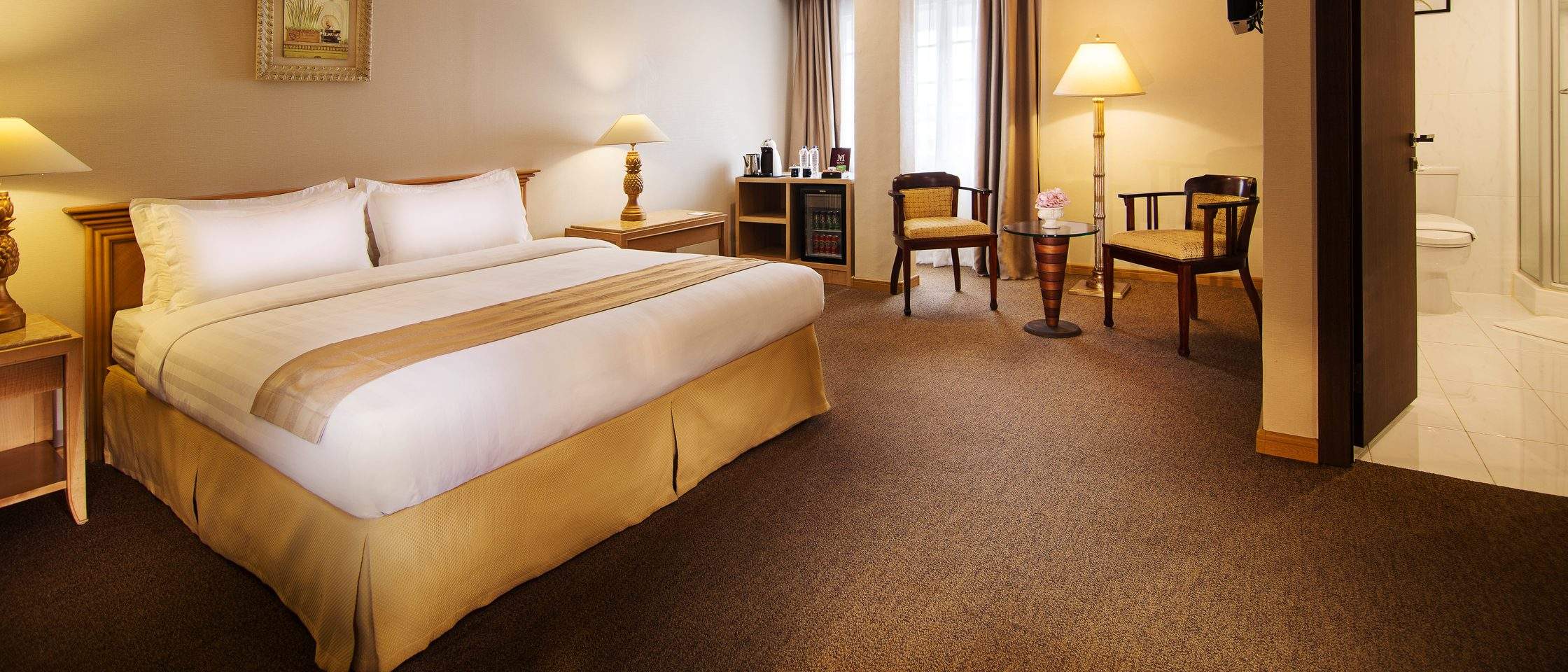
Photo: boutique heritage hotel suite (Menumbing Heritage Hotel, Belitung, Indonesia) · via Wikimedia Commons · CC BY-SA 4.0
This Month's Verdict
After government money exits, who is making money? Not by raising prices — by guest mix and cost control
Scope note: Jakarta — the special district caliber, excluding satellite cities. Hotels are one of Jakarta's most mature service-sector tracks, and the easiest for Chinese operators to enter — because Chinese teams' operational efficiency, OTA capability and corporate-client development give them real comparative advantage here. Read three numbers together: only one new hotel opened in H1, a 95-room re-branding (Ibis Budget de-flagged to Mercure); meanwhile a legacy five-star (Hotel Sultan) was repossessed by the government and shut down — new supply frozen, existing stock starting to clear. Government and SOE travel and meeting budgets were cut, and 3-4-star hotels relying on official guests lost 2.6 percentage points of occupancy; 5-star and luxury hotels serving business individual travelers and private-sector events gained 4.5 percentage points. Room rates are stuck (ADR flat at Rp1.19m/night, ~RMB 473, +0.0% YoY). The market is changing blood, not collapsing.
Three Numbers
95 rooms
So what: only one hotel opened citywide in H1, 95 rooms, and it was a re-branding — Ibis Budget de-flagged, hung with Mercure. This is not new supply; this is existing stock finding a new identity. Supply frozen.
Source: Cushman & Wakefield, Jakarta Hotel H1 2026 MarketBeat
+4.5pp vs -2.6pp
Counter-evidence: 3-4-star hotels accounting for 68% of room stock lost 2.6 percentage points of occupancy, while 5-star and luxury accounting for 32% gained 4.5 percentage points. What was cut was government travel budgets; what rose was business individual travelers and private-sector events — same market, two fates.
Macro backdrop: Indonesia 2026 GDP growth 5.2%, inflation 3.34%, central bank rate 5.75% (Bank Indonesia / BPS caliber, cited by the report). One sentence: volume is shrinking, price is flat, structure is shifting.
Metric
H1 2026
YoY / Change
Plain reading
Existing stock
43,749 rooms
-0.6%
The pool is shrinking — nobody dares build at scale
H1 net absorption
-3,105 rooms
——
Demand is falling (includes Sultan exit effect)
New supply
95 rooms
——
Half a year, one opening — and it was a re-brand
Exited supply
Hotel Sultan
——
Legacy five-star repossessed by government, zeroed overnight
Occupancy (Occ)
58.0%
+2.2pp
Sultan exit lifted the average — do not be fooled by the number
Average daily rate (ADR)
Rp1,190,000/night
+0.0%
Rates will not rise
Revenue per available room (RevPAR)
Rp690,200/night
+3.8%
RevPAR rose because of occupancy, not price
Source: Cushman & Wakefield, Jakarta Hotel H1 2026 MarketBeat, H1 2026 basis. FX: Rp17,917/USD (source report), 1 USD ≈ 7.1 CNY estimated (Rp/CNY ≈ 2,523). Net absorption of -3,105 is the source-report caliber (rooms), demand decline and Sultan supply exit not disaggregated.
Four Tiers, Two Worlds
The most valuable table in this report is the crack that appears when the market is split into four tiers: mid-market and upscale are already two completely different businesses. 68% of room stock in 3-4-star is bleeding; 32% in 5-star and luxury is gaining. The reason is simple — what was cut was government travel and meeting budgets, and government events mainly land in 3-4-star; 5-star and luxury guests are business individual travelers, foreign-firm and private-sector events, not on the government payroll, so policy cuts do not reach them.
Tier
Room share
Occupancy change
Who stays
Equator note
Luxury
~5%
+4.5pp (combined with 5-star)
Expat executives, high-net-worth individuals
Does not feed on public money; policy cuts miss them
5-star
~27%
+4.5pp (combined with luxury)
Business individual travelers (FIT), private-sector events
Same rise, same logic
3-4-star
~68%
-2.6pp
Government travel, SOE meetings, budget groups
Direct victim of budget cuts
Citywide
100%
+2.2pp
——
Sultan exit lifted the average; structural divergence is hidden
Source: same report. Note: the source report discloses occupancy-change magnitudes only (3-4-star combined -2.6pp, 5-star + luxury combined +4.5pp), not absolute occupancy rates by tier.
When This Verdict Breaks
① This report relies on a single agency dataset (Cushman & Wakefield), H1 2026 basis, verified as of Sep 21, 2026 — re-verify against the latest quarter before transacting. ② If the Indonesian government restores official travel budgets or SOE meeting spending policy loosens materially, the “government-guest exit is structural” verdict must be revisited. ③ Net absorption of -3,105 rooms is the source-report caliber; demand decline and Hotel Sultan supply exit are not disaggregated, so actual demand change may be overstated or understated. ④ Tiered occupancy changes are magnitudes only, with no absolute values; different methodologies may differ. ⑤ Hotel Sultan shutdown cross-verified via Kompas (2026-06-18), CNBC Indonesia (2026-06-17), and Antara Foto (2026-06-18). ⑥ Items marked “advisory judgment / experience” are non-statistical. This is a business reference, not legal or investment advice.
Evidence & Action
Supply Side: Freeze and Clearance
Only one hotel opened citywide in H1, 95 rooms, and it was a re-branding — Ibis Budget de-flagged, hung with Mercure. This is not new supply; this is existing stock finding a new identity.
At the same time, supply made a large subtraction: the legacy five-star Hotel Sultan in Senayan was repossessed by the government on June 18, 2026, and ceased operations. The Central Jakarta District Court (case 208/Pdt.G/2025/PN.Jkt.Pst) found the operator PT Indobuildco in violation of law; the ~13.7-hectare HGB land and buildings in GBK complex Block 15 were returned to the state, to be converted into open green space. The government deployed roughly 300 personnel for the joint clearance on execution day. (Cross-verified via Kompas, CNBC Indonesia, and Antara Foto reports, verified Sep 21, 2026; room count not separately disclosed by the report.)
Looking ahead, the construction pipeline totals 1,020 rooms across 2026–2028:
Year
Pipeline (rooms)
Notable projects
2026
400
——
2027
520
JW Marriott, Andaz, ParkRoyal
2028
100
——
Three-year total
1,020
Upscale and above ~65% (660 rooms)
Source: same report. Of the 1,020-room pipeline, JW Marriott, Andaz, and ParkRoyal — three upscale-and-above projects — total 660 rooms, about 65%: capital has already voted for the market.
Reading: new supply over three years is less than 2.5% of existing stock, and two-thirds is upscale. The mid-market will not see new enemies emerging from construction sites — your competitors are all existing stock, old properties poorly run and waiting to be re-branded or change hands.
The Cost Ledger: RMB-Caliber for Chinese Operators
Convert the numbers Chinese operators care about most into RMB:
Line item
Amount
Note
3-4-star ADR
~RMB 297/night
Rp750,000; the government budget-group price band
5-star ADR
~RMB 733/night
Rp1,850,000; business individual travelers and private-sector events
Luxury ADR
~RMB 1,387/night
Rp3,500,000; expat executives and high-end individual travelers
Labor, utilities, OTA commissions, management fees, maintenance
4-star annual net-profit ceiling (estimated)
~RMB 2.2–2.55m
Advisor's estimate, non-transactional data — a single mid-market hotel is not a cash cow
FX: Rp17,917/USD, Rp2,523/CNY estimated. ADR is the listed rack rate; actual transactions include OTA commissions and corporate-contract discounts; investment figures are estimates, not transactional data.
Two intuitive calibrations: first, a Jakarta five-star night at ~RMB 733 is roughly 60% of Beijing/Shanghai equivalents — for client entertainment and team travel, Jakarta's upscale hotels are cheap production inputs. Second, a RMB 7.26m annual room-revenue ceiling (100-room 4-star, citywide-average caliber) leaves limited margin after labor, utilities, OTA commissions and management fees — a single mid-market hotel in Jakarta is not a cash cow; it is hard-earned money from fine-tuned operations.
Demand Side: Government Money Exits, Who Picks Up
The demand-side keyword is “budget efficiency”: Indonesia's government and SOEs have compressed travel and meeting spending since 2025, landing directly on hotels that rely on official guests — both rooms and meeting rooms take a hit. The report's judgment is that this pressure will not ease in 2026.
The pick-up comes from three forces: business individual travelers (FIT), private-sector and professional-association events, and online individual travelers brought by OTA platforms. The report is explicit: hotels that used to feed on government money are collectively pivoting to these three guest types — during the transition window, whoever has stronger corporate-client and OTA operation capabilities will pick up the share others are surrendering.
One leading indicator to remember: Jakarta hotel occupancy is strongly correlated with Soekarno-Hatta International Airport passenger volume. Watch airport traffic — it is faster than any macro report.
And the annual pit that arrives on time: Ramadan 2026 runs February 18 to March 19 (Eid al-Fitr approximately March 20–21, verified via public calendar sources, verified Sep 21, 2026). March single-month occupancy was only 42%, 16 percentage points below the H1 cumulative average of 58%. Local business activity nearly halts during Ramadan — a seasonality unique to the Indonesian market that Chinese operators most easily overlook.
Equator's Take: Four Implications for Chinese Readers
Government money exiting is structural — do not wait for it to return★★★
Budget compression is not a temporary policy; it has run from 2025 to now with no sign of loosening. For 3-4-star hotels fed by official travel and government meetings, occupancy decline is a trend, not a cycle — do not touch these transfer deals, however cheap. (Advisory judgment, non-statistical)
Jakarta hotels are a dumbbell market: upscale rising, mid-market grinding★★★
5-star + luxury occupancy +4.5pp, construction pipeline 65% upscale and above — capital has voted. The mid-market (3-4-star) is 68% of stock, has the worst guest mix, and transforms the slowest — to survive in the mid-market, what matters is not the property but OTA operation and corporate-client development capability.
To enter: buy existing stock, re-brand, re-operate — do not build new★★★
The only “new opening” in H1 was a re-branding; the three-year pipeline is less than 2.5% of stock. Land costs, approval timelines plus 43,749 rooms of existing competition make new-build math fail. The opportunity is in poorly run existing properties — buy cheap, hang an international flag or reposition, and earn the spread with Chinese-team operational capability. (Advisory judgment)
Two life-or-death lines: Ramadan cash flow and land title★★★
Stress-test cash flow at the worst month: March at 42% occupancy; the annual average will lie to you. Land-title due diligence trumps all operating data: Hotel Sultan was zeroed overnight by an HGB title dispute leading to government repossession — check the land first, then the license, then the ledger.
Red Lines (Six Operating Boundaries)
01
Don't touch deals with high government-guest shareIn due diligence on a transfer, you must get the revenue split among OTA individual travelers, corporate-contract guests, and government guests; if you cannot get it, model the worst-case assumption
02
Land title is the ultimate riskHGB term, title chain, and pending litigation — all three must be clear before investing. The Hotel Sultan case from litigation to clearance is publicly documented; similar risks in Jakarta are not isolated (advisory judgment)
03
Stress-test cash flow at RamadanMarch occupancy 42%, annual average 58%. Using the annual average for loan-repayment modeling is digging your own hole
04
Do not model with a price-rise assumptionADR is flat per the report; revenue improvement can only come from occupancy and cost
05
If hotel F&B wants local guests, Halal is the first filterLiquor licenses are separate and zoned. A Chinese restaurant entering a hotel property must first confirm the property's Halal certification and liquor permit, then talk rent
06
Chinese guests are incremental, not the baseOccupancy follows total airport passenger flow, not just Chinese flights. A hotel model that serves only Chinese nationals cannot sustain occupancy in Jakarta (advisory judgment)
2-hour diagnosis
两小时诊断
Hotel site selection, existing-stock acquisition, operating plans, compliance paths — bring your questions and budget, and we will run the numbers in two hours. The first coffee is on us.
Data note: this report is Equator Creative Consulting's Chinese-language interpretation of Cushman & Wakefield's Jakarta Hotel H1 2026 MarketBeat (published 2026); underlying data copyright belongs to Cushman & Wakefield. Macro figures are cited by that report from Bank Indonesia and BPS. Hotel Sultan shutdown cross-verified via Kompas (2026-06-18), CNBC Indonesia (2026-06-17), and Antara Foto (2026-06-18); Ramadan dates verified via public calendar sources; all verified Sep 21, 2026. FX: Rp17,917/USD (source report); RMB at ~7.1 per dollar (Rp/CNY ≈ 2,523). RMB amounts are estimates. Limitations: ① single-agency dataset; ② net absorption of -3,105 rooms is the source-report caliber, demand decline and Sultan supply exit not disaggregated; ③ tiered occupancy changes are magnitudes only, no absolute values; ④ ADR is the listed rack rate, actual transactions include discounts; ⑤ advisory judgments such as “buyer's market” are not report statistics. This is a business reference, not legal or investment advice.