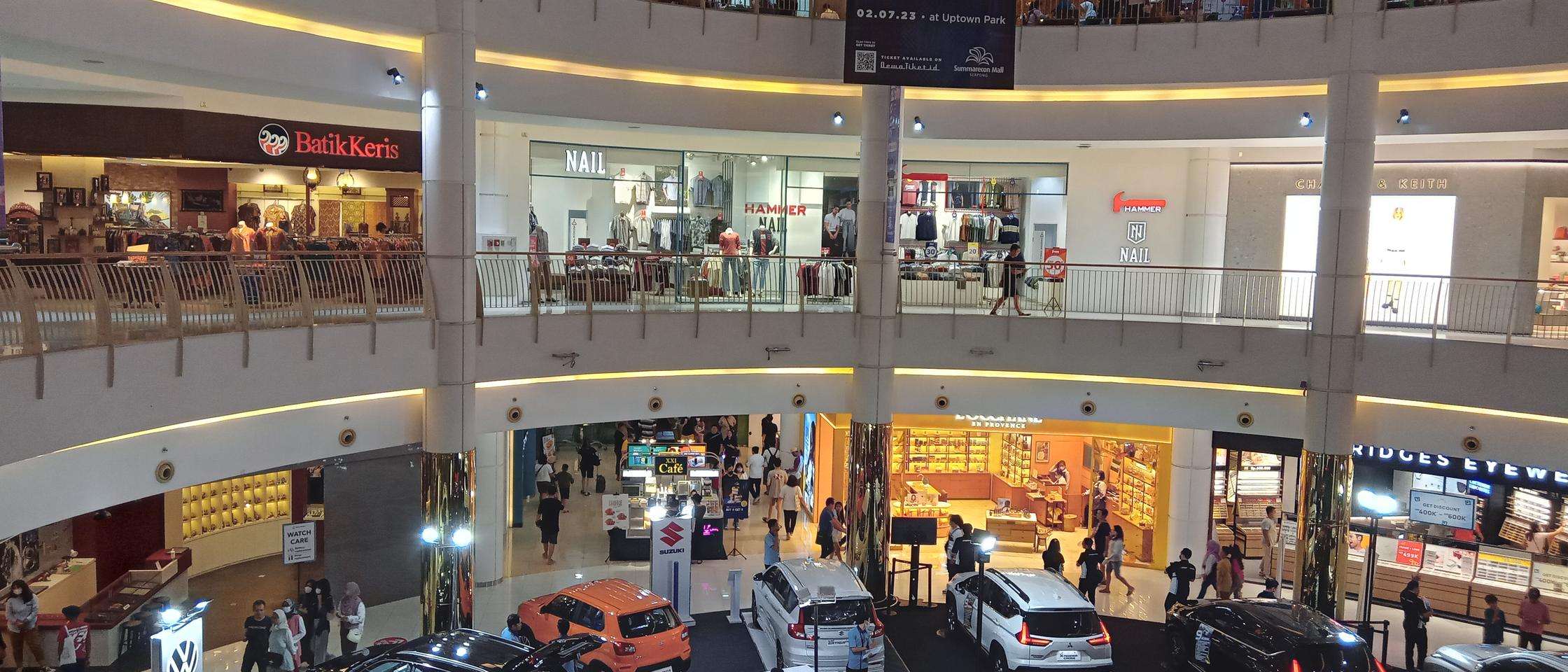
Photo: Summarecon Mall Serpong atrium, Tangerang (June 2023) · by Cun Cun · via Wikimedia Commons · CC BY-SA 4.0
This Month's Verdict
Satellite-city malls are a tenant's market: 1 in 5 units sits empty, and rent growth can't beat inflation — the leverage belongs to whoever opens a store
Debotabek — Depok, Bogor, Tangerang and Bekasi — is Jakarta's belt of “sleeping cities” and industrial corridors, home to a large share of the Greater Jakarta population; its malls are the most honest read on how Indonesia's middle-class families actually spend. H1 2026: vacancy at 22.9%, asking rents up just 0.8% in a year (against 3.34% inflation), and roughly 47,000 sqm of new mall supply due within 12 months. Stack the three numbers and the leasing KPI pressure on malls only grows. Malls want two kinds of tenants above all: those who make people stay for a meal, and those who make people stay for a workout — Chagee and Tianlala are already on this year's opening list. If you plan to open stores in Indonesia, this is the time to negotiate with data in hand, not to “wait and see”.
Three Numbers
22.9%
So what: overall vacancy is 22.9% — one in five units still sits empty (a 0.7pp improvement year on year). Demand is recovering (cumulative absorption +2.3% QoQ, occupancy up to 77.1%), but supply is growing too (+1.5%). Netted out, the market isn't bad — it's “holding”: malls hold on to fill space, brands hold on rather than exit, and nobody dares raise prices first.
So what: average base rent is IDR 462,300/sqm/mo, up just 0.8% in a year versus 3.34% inflation — real rents are quietly sliding; that is the definition of a tenant's market. Watch the other line: service charges at IDR 145,600/sqm/mo rose 2.9%, more than 3x faster than rent. Win the rent, leak the service charge, and you've won nothing.
Source: Cushman & Wakefield H1 2026 rent and service-charge statistics
47,000 sqm
Counter-evidence: about 47,000 sqm of new mall space enters the market over the next 12 months — vacancy can't come down and rents can't go up, so the window stays open. But it won't stay open forever: once vacancy falls back below 15%, the leverage changes hands. Time at the negotiating table has a shelf life.
Scope note: Debotabek's four satellite cities are Jakarta's “sleeping cities” and industrial belt — their mall data tracks everyday middle-class consumption. Macro backdrop: Indonesia 2026 GDP growth 5.2%, inflation 3.34%, central bank rate 5.75% (Bank Indonesia and BPS figures, as cited by the source report).
Metric
H1 2026
YoY
Plain reading
Total mall stock
3,214,000 sqm
+1.5%
The pie keeps growing — new malls keep opening
New supply in H1
48,700 sqm
——
Two new openings in Bekasi: Summarecon Mall Bekasi 2 (42,700 sqm) + G Avenue extension (6,000 sqm)
Overall vacancy
22.9%
0.7pp better
One in five units still empty — but better than last year
Average base rent
IDR 462,300 /sqm/mo
+0.8%
Below inflation (3.34%) — real rents are sliding
Average service charge
IDR 145,600 /sqm/mo
+2.9%
Rising 3x faster than rent — lock it down at signing
① This report relies on a single agency's dataset (Cushman & Wakefield); rents are gross asking rents, not signed transactions, verified as of Sep 24, 2026 — re-verify against the latest quarter before signing. ② If vacancy falls back below 15% quickly, the “tenant's market” verdict must be revisited. ③ The 15% rent-to-revenue safety line, the 10%–20% negotiation range off asking, and the 18-month payback threshold are advisory rules of thumb, not statistics in this report. ④ The data covers four satellite cities and cannot be applied to inner Jakarta (CBD and core retail districts price significantly higher). This is a business reference, not legal or investment advice.
Evidence & Action
Four satellite cities, four different games
Averages lie. Behind the same 22.9% vacancy sit four completely different business environments. Choose the city before the mall: for foot traffic and spending power, Tangerang; for value and leasing momentum, Bekasi; Depok is stable but small; Bogor — don't touch it without a specific local reason.
City
Stock (sqm)
Vacancy
H1 net absorption (sqm)
Asking rent (IDR/sqm/mo)
Equator note
Tangerang
1,358,600
21.2%
-4,100
497,700
Largest stock, priciest rents, 47,000 sqm under construction (incl. Jewel Garden at PIK 2). PIK's Chinese-Indonesian community is here — expensive, but traffic and spending hold it up
Bekasi
874,300
24.8%
+50,100
416,500
Highest vacancy, yet top absorption citywide — the new Summarecon Mall Bekasi 2 alone took 50k sqm. Cheapest rents in the metro: the value king
Bogor
640,600
27.4%
-11,500
Not disclosed
Over a quarter of units empty and people still leaving. Without a specific local reason, stay away
Depok
340,600
16.7%
+400
467,500
Lowest, steadiest vacancy — but the smallest pie and almost no new supply. Stable also means few openings
Total / average
3,214,000
22.9%
+34,900
462,300
Marginally better overall, sharply divided — city before mall
Source: Cushman & Wakefield H1 2026; rents are gross asking rents. Bogor rent not broken out in the source report.
The rent ledger: what a 100 sqm shop costs per month
Convert the satellite-city average asking rent into the monthly bill for a standard 100 sqm unit. Then run the F&B rule of thumb backwards: rent plus service charge should stay within 15% of monthly revenue — a unit costing ~IDR 60.8mn a month needs monthly revenue above IDR 400mn (~RMB 160k) to clear the safety line. For any category or location that can't reach that number, cheap rent is still a loss.
Item
Unit price (satellite-city avg)
Monthly cost, 100 sqm unit
Base rent
IDR 462,300 /sqm/mo
IDR 46,230,000
Service charge
IDR 145,600 /sqm/mo
IDR 14,560,000
Total
IDR 607,900 /sqm/mo
IDR 60,790,000 ≈ US$3,392 ≈ RMB ~24,000
FX follows the source report at IDR 17,917/USD; RMB converted at ~7.1 per dollar, for intuition only. Figures are asking rents — transactions are negotiable; inner-Jakarta (CBD and core districts) prices significantly higher and is not comparable.
Who is taking space: F&B and the “time-selling” formats
The new faces in H1 malls show exactly what leasing managers want. Two signals deserve singling out. First, tea drinks are the most crowded track — China's premium leader (Chagee) and its budget challenger (Tianlala) are now fighting in the same market, plus local brands; there are only so many ground-floor slots for tea, and latecomers get worse positions on worse terms. Second, Wellground took 17,587 sqm in a single deal — malls are replacing department stores with sports-and-wellness centers as anchors: any format that keeps people on-site for two hours is a format malls will discount for.
Brand
Format
Location
Why it matters
Chagee
New-style tea
Summarecon Mall Serpong
China's tea-drink leader keeps densifying Indonesia
Tianlala
Budget tea
Mall Alam Sutera
China's lower-tier tea brand pushes into the satellite cities
Mimatcha / Sancha / Taro Bun / GAGA
Tea · bakery · dining
Eastvara, AEON Deltamas, Margo City and others
F&B was the undisputed expansion engine of H1
Wellground
Sports & wellness center
Summarecon Mall Bekasi 2
17,587 sqm in one deal — courts + a Hyrox gym as the new anchor tenant
Vertex 8
Sports & wellness center
Eastvara Mall
“Time-selling” experiences are replacing “goods-selling” retail
Under Armour / MiX Store
Retail
Summarecon Mall Bekasi 2 / Pakuwon Mall Bekasi
Traditional retail still opens — but small tickets (176–300 sqm)
Source: Cushman & Wakefield H1 2026, “brand expansion” and “key leases” sections (renewals not counted).
Five Actions for Store Opening
This is a negotiation window, not a waiting period★★★
22.9% vacancy, rent growth below inflation, and new supply on the way — stack the three and mall leasing KPIs only get heavier. Rent-free periods, fit-out subsidies, pure turnover rent (no base) or low-base-plus-turnover structures are all more negotiable than two years ago. The window won't stay open: once vacancy returns below 15%, the leverage changes hands.
Negotiate with an “F&B + experience” mix — you'll get terms pure retail can't★★★
What malls lack is not goods but dwell time. Pure-merchandise small shops are increasingly dispensable to them (H1's new retail leases were small 176–300 sqm tickets), while formats that let people eat, play and sweat are treated as lifelines. The closer your format mix is to a “destination”, the stronger your position at the table.
Choose the city before the mall★★☆
For traffic and spending power, Tangerang (expensive, but PIK's Chinese community holds it up); for value and leasing momentum, Bekasi (cheapest rents, top absorption); Depok is stable but small; Bogor needs a specific local reason. Top malls (Summarecon and AEON systems) run far below average vacancy with far harder terms — 22.9% is the market average; don't negotiate a prime mall with an average number.
The education cost for Chinese brands has already been paid★★☆
Chagee, Tianlala and the Mixue system have educated Indonesian mall leasing departments: they know Chinese brands bring queues and buzz. Latecomers no longer need to explain “what a Chinese brand is” — only “how you differ from the ones already here”. That is a real latecomer dividend.
The macro floor is fine — but don't open stores on leverage★★
GDP growth at 5.2% and inflation back to 3.34% keep the consumption base steady; but the central bank rate still sits at 5.75% and local financing is expensive. This market suits self-funded stores with fast payback, not borrowed-money scale bets. If a store can't pencil out an 18-month payback, better not to open it.
Red Lines (six operating boundaries)
01
Scope: satellite cities are not inner JakartaQuote satellite-city rents at a CBD negotiation table and you'll be read on the spot
02
The average trap: cheapness itself is the disease22.9% is a market-wide average — however empty a weak mall is, however cheap the rent, don't go in
03
Asking is not signing — but don't expect half offA reasonable target is 10%–20% off asking, plus rent-free period and fit-out subsidy
04
The service charge is the hidden arrowRent +0.8%, service charge +2.9% — write the annual cap and adjustment mechanism into the contract, or three years on, your profit lives inside the service charge
05
Halal is F&B's first filterBefore entering a mall, confirm your category, supply chain and menu can pass halal requirements — it decides whether you can serve Muslim customers at all, not a nice-to-have
06
The 15% rent-ratio red lineAny location where rent + service charge exceeds 15% of projected revenue is a no-sign (advisory rule of thumb, not a statistic)
2-hour diagnosis
两小时诊断
Reading the data is step one; running the numbers on your own catchment, category and menu is the decision. Site comparison, rent-to-revenue ratio, payback period — bring your project and we'll do the math. The first coffee is on us.
Data note: this report is Equator Creative Consulting's Chinese-language interpretation of Cushman & Wakefield's MarketBeat: Debotabek Retail H1 2026 (published 2026); underlying data copyright belongs to Cushman & Wakefield. Macro figures are cited by that report from Bank Indonesia and BPS. FX: IDR 17,917/USD (source report); RMB at ~7.1 per dollar. Limitations: ① single-agency dataset; rents are gross asking rents, not signed transactions; ② Bogor rent not broken out in the source; ③ demand and absorption statistics exclude renewals; ④ rules-of-thumb judgments (15% rent ratio, 10%–20% negotiation range, 18-month payback) are advisory judgments, not report statistics. This is a business reference, not legal or investment advice.